Binance account closures in Europe. What to do now?

If you hold a Binance account in France, Spain, Italy, or Poland, your account is scheduled to shut down on 31 December 2026. Even before that date arrives, a monthly custody charge kicks in on 29 November: 0.025% of whatever crypto remains on the platform, or 10 USDC, whichever costs you more.
Binance lost its route to an EU-wide passport after failing to secure a MiCA licence, which already forced the exchange to curb services across the bloc back on 1 July. The company isn’t folding globally and withdrawals remain open, yet European customers now have a hard clock ticking.
Moving your coins off the exchange is only part of the job. Once Binance pulls the plug on your dashboard, you lose access to the records tax offices routinely ask for years down the line, and public blockchains won’t reconstruct your original purchase prices for you.
Key dates for Binance closures in Europe
6 things to do before the deadlines
- Confirm that your account is affected. Look for Binance’s notice and check it inside your account. Type the address yourself: do not follow links in emails.
- Download your records first. Once the account closes you lose the dashboard. The full list is further down.
- Import them into your tax tool while your API key still works.
- Redeem Earn and staking positions. Locked products take time to release.
- Withdraw to your own wallet or to a provider authorised under MiCA. You can check any provider on ESMA’s register. Keep the transaction ID of each withdrawal.
- Check the tax effect before you sell or swap. A transfer is not taxed. A sale is, and a swap depends on your country: see the table further down.
| Date | What happens | What to do |
| 29 November 2026 | First monthly fee calculated on remaining crypto (0.025% or 10 USDC), debited within three days | Export all records and empty the account beforehand |
| After 24 December 2026 | Second monthly fee calculation | Clear out any stray balance before the charge hits |
| 31 December 2026 | Affected accounts close; leftover funds may be auto-converted or moved | Keep your CSVs and withdrawal receipts backed up offline |
What actually happened with Binance’s MiCA application in Greece
Rumours circulating online claim Greek regulators formally rejected Binance’s MiCA bid, though technically the exchange pulled the plug first.
| Date | What happened |
|---|---|
| January 2026 | Binance files its MiCA application with the Greek regulator (HCMC) through a Greek subsidiary. |
| 16 June | Reuters reports that the HCMC is preparing to reject the application. |
| 24 June | Binance withdraws the application, less than a week before the deadline. |
| 1 July | The MiCA transitional period ends across the EU. Binance’s local entities stop offering crypto services: no deposits, no trading, no Earn products. Withdrawals stay open. |
| 2 July | France’s AMF records Binance France’s registration, held since May 2022, as lapsed. |
Binance maintains that its paperwork was complete and blames repeated delays on the Greek authority, adding that it plans to apply in another, unnamed EU member state. As of 7 November, however, zero Binance entities appear on ESMA’s register of authorised crypto-asset service providers.
In practical terms, the outcome across France, Spain, Italy, and Poland is identical, local registrations expired alongside the transitional period, leaving Binance without an EU passport to keep operating there.
How Binance suffered the largest hack in cryptocurrency history
On 29 October, Binance suffered the largest crypto heist on record, losing roughly $6.3 billion from its wallets in about twenty minutes. Two days later, the FBI pinned the attack on TraderTraitor, a hacking group linked to North Korea, an accusation Pyongyang denies. Binance says it is absorbing the hit out of pocket and has already replenished 98% of the affected reserves.
Nine days after the breach, on 7 November, Binance announced that CFO Kaiser Ng was stepping down to be replaced by Justin Yek, framing the move as a transition planned six months earlier rather than fallout from the theft.
October’s security breach has nothing to do with why European accounts are closing; that comes down strictly to MiCA. The only reason it matters here is operational. Binance has been reopening withdrawals network by network since 1 November, so verify early that your specific tokens can actually be withdrawn well ahead of 29 November
How the 29 November Binance fee eats into smaller balances
Starting 29 November, any affected account still holding crypto incurs a monthly charge of 0.025% or 10 USDC, whichever is higher. The first debit lands within three days, followed by a second sweep after 24 December.
On paper, 0.025% looks harmless. The 10 USDC floor is what stings, anyone holding less than 40,000 USDC pays the flat minimum every single month.
| Account balance (USDC) | Monthly fee (USDC) | Cost as a share of the balance |
|---|---|---|
| 100 | 10 | 10% |
| 500 | 10 | 2% |
| 5,000 | 10 | 0.2% |
| 40,000 | 10 | 0.025% |
| 100,000 | 25 | 0.025% |
If the balance is smaller than the fee, Binance can take whatever is left. The charge comes out of USDC first and, failing that, other crypto. Anyone who withdraws everything before 29 November pays nothing. Redeem Earn and staking positions early: locked products take time to release.
These terms come from the email Binance sent to affected customers, first published by the French press. Binance has not posted them publicly, although its terms of use already allow a monthly fee on dormant accounts. Check the notice sent to your own account.
Which European countries are affected
The closure of affected accounts on 31 December is confirmed by Binance; a Binance exit from Europe is not. A spokesperson told CoinDesk on 7 November that the wind-down is being managed in stages and that there is “no sudden freeze” of customer assets.
| Where you live | Status at 12 November 2026 |
|---|---|
| France, Spain, Italy, Poland | Closure notices reported. Binance ran locally registered entities there. Deposits are blocked; crypto and fiat withdrawals are open. |
| Belgium, Sweden | Restricted since July (new registrations, deposits, selected products). No closure date reported. |
| Rest of the EU | Covered by Binance’s wider post-MiCA restrictions. Users in countries without a local Binance entity, such as Portugal, have not received the same notice. |
| United Kingdom | Outside the EU and MiCA. The notices reported so far concern EU countries only. |
Two big questions remain unanswered: what exact conversion rate or mechanism Binance will apply to balances left after 31 December, and which EU country it intends to target for its next MiCA filing.
Nobody is freezing your coins overnight. What can burn you is leaving a stray balance sitting in the account, having Binance liquidate or convert it on a date and at a price you didn’t choose, and then getting stuck in extra compliance checks to recover the cash.
Which records to download from Binance before your account closes
Download your full history before you withdraw the last euro, not after. Once the account is closed you lose access to the dashboard, your API key can be expected to stop working, and Binance has not said what records it will provide after 31 December.
The full list, in order of importance:
- Complete transaction history. On the web: Assets, Asset History, Export Transaction Records. Choose a custom range starting from your first transaction, with all accounts and all coins, in CSV.
- Spot trade history and Convert history. These do not always appear in full in the general file.
- Crypto deposits and withdrawals, with the transaction ID (TxID) and destination address. This is your proof that a transfer went to your own wallet and was not a sale.
- Fiat deposits and withdrawals, so that money in and out can be matched to your bank statements.
- Earn, staking and Launchpool rewards, plus airdrops, cashback and referral commissions.
- Futures, margin and options, if you used them: realised PnL, funding fees and loans.
- Recurring buys, P2P, Binance Pay and card transactions. These are the ones most often missing from standard exports.
- A balance statement at 31 December of each year, and one more just before you empty the account.
- Binance’s emails about the closure and the confirmation of each withdrawal.
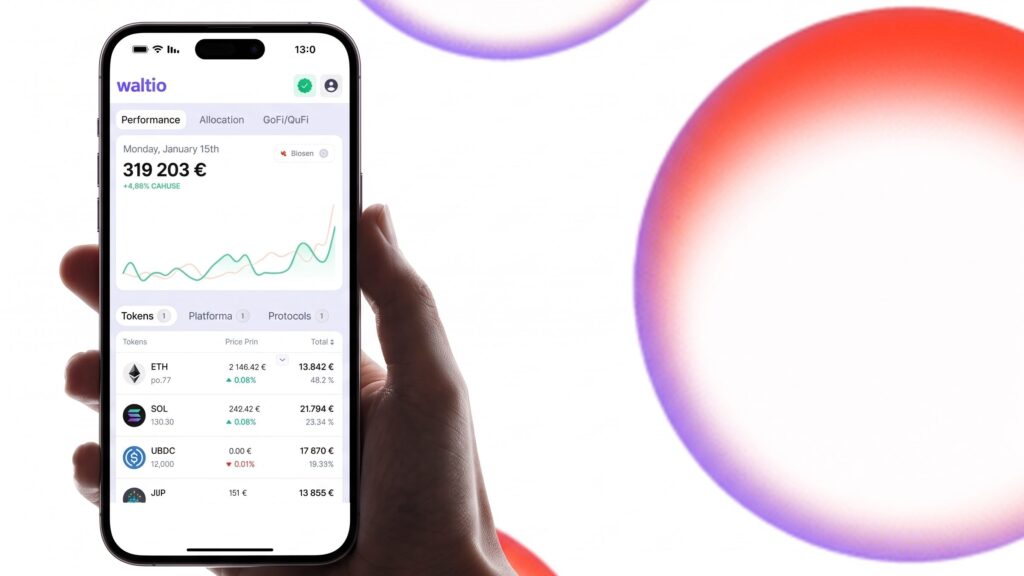
Import your Binance account into Waltio by API plus history file while the account is still open. Your transaction history is then stored outside Binance, ready for your tax return.
Three practical limits apply. Binance caps the number of exports per month (between 15 and 40 per user), so do not spend them on tests. Long periods can take hours to generate. And the download link expires after 7 days.
Keep the original files unedited, in two separate places. Be wary of any email that rushes you: a closure with a date is ideal ground for phishing. Always type Binance’s address yourself instead of following a link.
If the account is already closed, Binance runs a data request service for closed accounts that sends an encrypted report by email. It is slower, the format is not built for tax calculations, and nobody has confirmed how it will cope with a mass closure. Do not rely on it as your main plan.
European tax rules when moving off Binance
Simply transferring your coins to a personal wallet or another exchange isn’t taxable because ownership never changes. Taxes come into play if you cash out or swap coins along the way, and the rules vary sharply across borders:
| Country | Sale for euros | Swap into another crypto or a stablecoin | Reference |
|---|---|---|---|
| France | Taxable | Not taxable | BOFiP, BOI-RPPM-PVBMC-30-10 |
| Spain | Taxable | Taxable | Agencia Tributaria |
| Italy | Taxable | Not taxable between crypto-assets with the same characteristics and functions; taxable into an e-money token such as USDC | Art. 67(1)(c-sexies) TUIR; Agenzia delle Entrate, Circular 30/E of 2023 |
| Poland | Taxable | Not taxable | podatki.gov.pl |
| Belgium | Taxable on gains from 1 January 2026, above a €10,000 yearly exemption | Taxable | Act of 6 April 2026; Circular 2026/C/74 |
| Sweden | Taxable | Taxable | Skatteverket |
| Germany | Taxable if held one year or less, above a €1,000 yearly threshold; tax-free after | Same rule as a sale | § 23 EStG |
| Portugal | Taxable if held under 365 days; exempt after | Not taxable | Waltio guide to Portugal |
(Note: France, Spain, Italy, and Poland face confirmed closures; Belgium and Sweden face ongoing restrictions; Germany and Portugal fall under broader EU limits. Rules above apply to private individuals rather than professional traders.)
Two cases deserve attention. The monthly fee is taken in crypto, and paying for a service in crypto generally counts as a disposal. Any conversion Binance carries out after closure follows the same table, except that the date and the price are set by Binance.
2026 is also the first year covered by DAC8, the EU directive under which crypto providers report their users’ transactions to tax authorities. The first exchange of data between member states is due by 30 September 2027. Your return will be compared with what platforms report, so your own records need to reconcile.
Year-end matters too. Spain’s Modelo 721 is based on crypto held with foreign providers at 31 December. Italy’s Quadro RW and France’s form 3916-bis look at the whole year: the French form covers every foreign crypto account opened, held, used or closed during the year, so a Binance account closed in 2026 may still need to be declared.
Keep the records longer than you think. Limitation periods differ by country, but cost basis has to be proven when you sell, even if you bought in 2019. As long as you hold crypto bought on Binance, you need that history. This is general information, not tax advice.
How to back up your Binance history in Waltio
The safest way not to lose your history is to import it into a tax tool now, while the account is still live. In Waltio, the full Binance integration combines two sources, and it needs both:
- A read-only API key. Create it under API Management with Enable Reading ticked. If you traded futures, tick that option as well. Do not use the Tax Report API key type: it can be incomplete.
- The transaction history file. It captures what the API does not return and prevents gaps in the calculation.
If you used margin, referrals, recurring buys, options, mining, or P2P, download those dedicated CSVs and upload them alongside the main file.
Run the sync before draining your account so you can verify that Waltio’s calculated balances match what Binance displays on screen. Spotting a discrepancy now gives you time to hunt down a missing file, spotting it in January will be too late.
Create a free Waltio account and import Binance today. The deadline that matters is 29 November, not 31 December.